Tuesday, April 21, 2015

Resiliency in Schools

Resiliency is thought of as a strong and tough characteristic. Someone with resiliency demonstrates the capacity to recover and rise from difficulties they have faced.  
  • Do young adolescents have the capability to be resilient?  
  • Can students overcome hardships with toughness to change, cope, and grow?  
  •  What if those hardships are living in poverty, having endured sexual abuse, or the death of a parent? 

With support from caring adults who promote resiliency, lives of teenagers can be dramatically influenced to overcome their circumstances and use their experiences to succeed. School counselors have knowledge, skills, and expertise to provide support to help make students successful.  Together with teachers, counselors can provide interventions in school to increase student resiliency.


School counselors play a crucial role in identifying students who have been negatively impacted by life experiences and promoting and teaching resiliency.  Students can be empowered when taught resiliency skills to help stabilize their lives no matter what adversity they have faced or will see in their life.  Counselors have a special position to help students build a toughness and an ability to bounce back and be even stronger than before with a little guidance and a positive school community.

Tuesday, April 14, 2015

Promoting Resiliency in a School Counseling Program


Resiliency can be defined as, “The set of attributes an individual possess which enables him/her to bounce back from adversity, frustration, and/or misfortune” (Janas, 2002 & Sagor, 1996). Resilient students are viewed as social, optimistic, cooperative, inquisitive, attentive, helpful, punctual, and on task (Sagor, 1996). He or she is empathetic, determined, hopeful, persistent, autonomous, and possess a sense of humor, effective communication skills, and good problem solving skills (Bernard, 1993). These are the character traits that allow some students to overcome adversity and continue to succeed in his/her life. 


Examples of strategies include: 


  • Evaluate all students based on character strengths and apply the information to provide classroom guidance lessons, individual counseling, and to form counseling groups. A strength-based approach has been shown to accentuate character strengths which, in turn, promotes resiliency among students. There are several questionnaires that can be administered to students, which helps discover character traits. Building resiliency through classroom guidance lessons on character strengths, is effective and reaches many students at one time.


  • Collaborate with families, school staff, and the community to provide a strength-based approach to empowering students. When a school counselor collaborates with student’s families, school staff, and the community, it provides important opportunities to enrich a student’s character traits and enhance resiliency. Some examples of collaboration may be: classroom guidance lessons based on student’s specific needs; peer mediation and peer counseling; peer mentoring; a school wide bullying prevention program; group counseling with student’s and/or families; children and staff birthday celebrations; mentor-ships with individuals in the community; and various clubs and enrichment programs based on student’s interests and needs. Collaborating with families, school staff, and the community, will not only build resiliency for a student in the school setting, it will also assist him/her in the application of resiliency in other areas of his/her life.

  • Shift from a deficit-focused to a strengths-based and solution-focused approach to advocate for all students. School counselors are leaders in the school. If we build on student’s strengths and advocate for all students, the school staff will follow. By acknowledging a student for his/her positive attributes, and not by his/her negative attributes, it will allow school staff to view him/her differently. A teacher may express frustration with a student for constantly talking out of turn in class. From a strength-base focused perspective, a school counselor may offer a suggestion such as, “I bet that is very frustrating. It sounds like that student has some amazing ideas that he/she is wanting to share with the class? Could we brainstorm some ways for him/her to express his/herself without disrupting class?” By acknowledging the teacher’s frustration and then refocusing his/her deficit in the classroom to a strength of the student, it will encourage the teacher to view the student as a strength instead of a deficit to the classroom.

The continuing challenge for school counselors is to reach all students and provide them with the tools they need to succeed academically, socially, emotionally, and in their careers. By promoting student’s character strengths, collaborating with families, school staff, and the community, shifting from a deficit-reduction to a strength-based approach, and continuing to educate ourselves, we can build resiliency among students and help them achieve their goals!

References
Bernard, B.  (1993). Fostering Resiliency in Kids.  Educational Leadership, 51(3), 44-48.
Janas, M.  (2002). Build Resiliency.  Intervention in School & Clinic, 38(2), 117-121.
Sagor, R.  (1996). Building Resiliency in Students.  Educational Leadership, 54(1), 38-43.


Tuesday, March 17, 2015

Classroom Management Strategies in the High School

Types of High-Risk Behaviors
  • Passive – Behavior that avoids the domination of others or the pain of negative experience.
  • Aggressive – Behavior that overpowers, dominates, harms or controls others without regard for their well-being. The child has often taken aggressive people as role models and has had minimal or ineffective limits set on behavior.
  • Attention Problems – Behavior demonstrates either motor or attentional difficulties surfacing as hyperactive or inattentive behavior.
  • Perfectionist – Behavior that is geared toward avoiding embarrassment and assumed shame from making mistakes. The child has unrealistically high expectation of self.
  • Socially Inept – Behavior that is based on the misinterpretation of nonverbal signals of others. The child misunderstands facial expressions and body language.           

Setting Classroom Rules Early

Take time at the beginning of the year to set classroom rules. Engaging the students in the process of determining class riles and expectations creates a positive environment from the start.

Cool Down Time
  • Allow for cool down time when a student feels angry or upset.
  • Designate an area of the classroom at the beginning of the year and explain that it is for any student who needs a moment to cool down, calm down or just needs a quiet space.
Reflective Essay
  • In some cases, it might be helpful to assign a reflective essay after an incident. Ask the student to (1) identify their role in the conflict, (2) discuss other’s role in the conflict, (3) identify at least one idea to resolve the current problem, and (4) how in the future can the student prevent the behaviors from reoccurring.

Behavior Management Strategy: Group Time/Community Building
  • Group time can be used to effectively deal with student’s negative and disruptive behavior by building and strengthening student's social skills and self regulation while developing caring and supportive relationships among students.
  • By building a sense of community within the classroom the teacher promotes feelings of concern and respect among classmates, ideally leading to a less disruptive atmosphere.

“Face-Saving Out”
  • Another strategy for a teacher is the “face-saving out”.  This could be used as a last resort before a student is asked to come to the counselor’s office or other disciplinary measures.
  • The idea is to ask the student directly right after the incident if there is anything they can change to stay in the classroom.
  • Allowing the student a second chance shows a positive, trusting relationship and that the student is being treated with respect.  Hopefully, students will come up with realistic solutions when confronted with a second chance.


Classroom Management and How We Can Help!
  • When applied correctly, effective classroom management strategies can assist students across a range of behaviors and all developmental levels.
  • Good strategies can help effective manage student’s behavior and ability to learn because they promote and strengthen social and emotional development, which can lead to academic success.
  • As with therapeutic interventions, building and maintaining a positive relationship with your students in the classroom and school setting is important to make a difference in their lives.
  • Positive approaches, rather than punitive responses, to their misbehavior emphasizes social learning, problem solving skills, and positive self worth.
  • Rewarding positive behaviors when a student is showing appropriate social and academic behaviors strengthens students’ feelings of a positive, trusting relationship with teachers.

Picture Sources:
http://whoswhoandnew.blogspot.com/2014/07/setting-tone-in-first-10-minutes-of.html
http://www.lauracandler.com/strategies/classmanage.php


Tuesday, March 10, 2015

Behavior Management Strategies: Middle School

Causes of Behavioral Issues
Managing the behavior of seventh and eighth grade students can be challenging, to say the least. Their behavior can be baffling for educators and counselors alike to understand. In managing these issues, one must remember all of the difficulties these students are facing.

Development
As students go through puberty and transition into adulthood, their body experiences many changes. These changes may make them seem older and they may try to act older to accommodate these changes. However, as counselors, we need to remember they still have developing, impressionable minds that are still maturing.

Transition from Elementary to Middle School
The transition from elementary school to middle school proposes many changes. Students must adjust to new teachers, seven classes per day in different classrooms, meeting new students and a new setting. In addition, the expectations are greater and students must work harder than they had in the past. Adjusting to these changes may cause students to feel stressed and to act out in ways that they normally would not. 

Peer Pressure
Most seventh grade students desire to fit in with their peers. At this age, cliques begin to form and many students begin to consider other’s opinions. Students may misbehave to impress and gain acceptance from others.

Behavior Management Strategies: Classroom
Here is a list of strategies that educators can do to lend an environment of structure and order to the classroom:
  • Model the behavior that is desired.
  • Use a calm voice. For instance, if a student raises her voice, respond with a calm, even tone.
  • Clear expectations and rules.
  • Step-by-step learning and scaffolding.
  • Positive reinforcement.
  • Monitoring the class closely.
  • Prepare for the worst. Always have an extra lesson plan, just in case.
  • Establish time limits and ensure students finish their work before leaving.
  • Read the room frequently to ensure students are engaged.
  • Use a Points System. Reward students for good behavior and provide incentives for consistent good behavior. Prizes can be intangible, such as listening to music with headphones while working.
Behaviors that May Require a Counseling Intervention
Counselors are always available as a resource to teachers and an advocate to students. The following behaviors may require a counseling intervention to ensure student safety and that the behavior is not an indication of a larger issue:
  • Physical threats and violence (toward other students, educators or administrators)
  • Bullying (this can take the form of mental or physical intimidation)
  • Refusal to do classwork
  • Skipping class
  • Disrupting class (when a student’s behavior is so disruptive it is interfering with other students’ ability to learn)
  • Drug or alcohol abuse
  • Sexual activities
  • Self-harm
  • Suicidal Idealization
  • Poor Academic Performance
  • Poor Social Skills
Behavior Management Strategies: Counselor Interventions
Some students may need a little extra help or motivation. Here are some interventions that are appropriate for counselors to implement at the middle school level:
  • Change of classes: This is an option for students who are being negatively impacted by their environment and peers or are not a good academic fit for the class. 
  • Why Try: This program is often used in behavior intervention classrooms. It involves goal setting and journaling and can be effective in not only teaching students proper behaviors, but also empowering them to live beyond the status quo.
  • 504 & IEP Plans: Students can be assessed to see if extra accommodations would help them to be more successful.
  • Behavioral Intervention Plan: Students work with their counselor and teachers to determine a plan to help them to manage their behavior. For example, a student with anxiety may be allowed to have a stress ball to use during class.
  • Specialized classes and alternative programs: The traditional classroom is not always the best fit. This is a good option for students facing trauma.
  • I CAN: Tutoring can help students who are struggling academically.
  • Outside counseling services: students facing traumatic circumstances may need to see a specialist.

Tuesday, February 24, 2015

Behavior Management Strategies: Elementary Education

As Teachers, Administration and School Counselors it is so important to model behavior expected from our students. Classroom management not only affects the teachers but affects how an administration and school counselor can function as well. Students need to feel safe and comfortable in order to learn and be productive. When teachers can create an environment free from high risk behavior and disruption everyone wins.

The following are just a few examples of classroom management:

Quiet Zone

Image result for quiet reading corner in classroomStudents are asked to remove themselves from the situation and sit in a quiet spot away from distraction, preferably in a comfortable chair/beanbag to gather their thoughts. There, a teacher may also take the time to quietly ask the student what they can do to help them be less agitated or resolve what is distracting them. This is an opportunity for the student to calm their nerves, reading a book is a great way to refocus and lower anxious behavior.

Buddy System

**This strategy will need direct communication between teachers, counselors and administration. 

Supplies:

  • A teacher with a free period (empty classroom)
  • All administration, counselors and teachers open communication and agreement
  • Student takes homework or a book to read in new classroom

If a student is have trouble focusing, disrupting a classroom or becoming irritated to high level this may be a very helpful strategy. If a student is having trouble they may enter another classroom with another teacher's supervision to continue their work alone. This works when all teachers have consented and are open to watch the student. The positives of this strategy are the student has an opportunity to clam their nerves, work on homework, not distract other students and continue learning in a less distracting environment.


Clip Up - Clip Down 
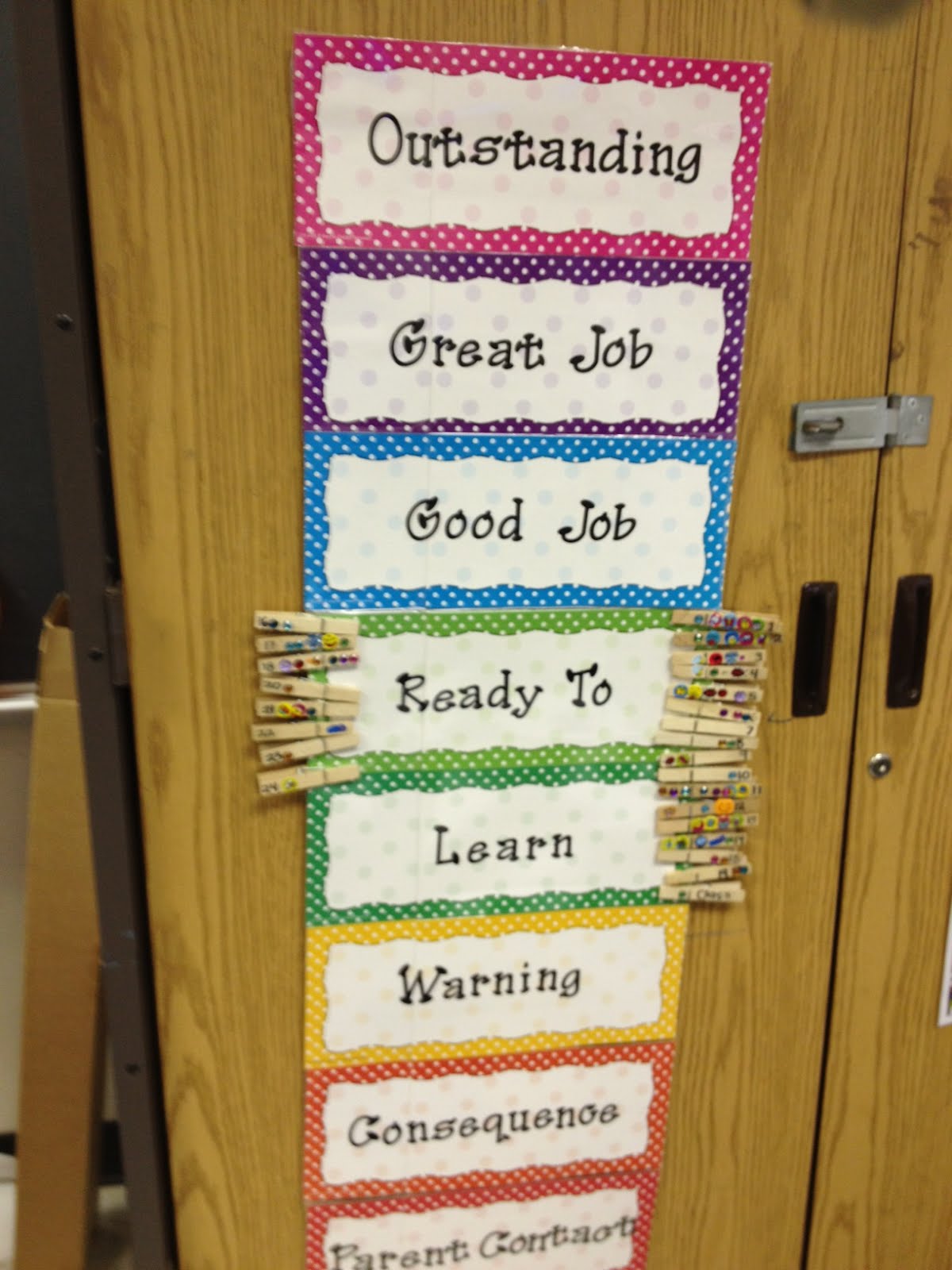
A Clip Up and Down chart is a chart that has each students' name on a clip and at the beginning of everyday they begin at "Ready to Learn." As the day progresses under the teacher's discretion students may move up or down the chart. This chart is placed in order to promote positive behavior not discipline or embarrass students if they are "clipped down." Promoting students to move up and not continuously move down is the goal.

*Teachers should understand the implications and take discretion when moving students down the board, moving one down or two may be acceptable, but if behavior reaches further involving administration is recommended. 

A behavioral chart in the classroom depicting student's behavior throughout the day is a great visual for students to be reminded how they are doing in class that day. It is also a great reminder to students where they currently stand in regards to their performance in the classroom. Rewards or sincere praise are recommended for students' movement up in order to promote behavior.

Strategies continued...

  • Model expected behavior
  • Give instructions on behavior expected at the very beginning of class, school or in counseling session. 
  • Advise of consequences of behavior
  • If, expectations are violated follow through with consequences
 

Wednesday, February 11, 2015

Gonzaga School Counseling Graduate honored at the White House

“I know when I started my career, I wanted nothing more than to be an advocate for those without a voice, and to collaborate to make systemic changes in my school to provide a more equal educational environment.” 


From the School Counseling program here at Gonzaga University, as well as the rest of Counselor Education, we would like to congratulate graduate Cory Notestine on being selected as the 2015 ASCA School Counselor of the Year!

On January 30th, Cory was honored at the White House surrounded by other inspiring individuals including fellow school counselors, actress Connie Britton, and first lady Michelle Obama. The 36 School Counselor of the Year finalists and 5 semi-finalists were recognized as well, as Michelle Obama painted the following picture of counselors in our schools:

"...they help our young people get to where they want to be in their lives. And they do it with patience and compassion, and sometimes even a little tough love. Our school counselors convince students that they have something special, each of them, to offer, and they push those students to dig deep and fulfill every last bit of their potential."

Cory is an inspiration to burgeoning and practicing school counselors and we look forward to see the continuation of his positive impact in years to come.

Image retrieved from: http://www.whitehouse.gov/blog/2015/01/30/white-house-honors-2015-school-counselor-year

Wednesday, February 4, 2015

National School Counseling Week

Happy National School Counseling week
from the Gonzaga School Counseling Program!
 
Here are few "sweet ideas" of how you can celebrate this week!